
Fuel Cell Facility

This is a state-of-the art facility designed for ceramic processing and early-stage manufacturing of fuel cells. The facility comes equipped with a suite of analytical capabilities (Particle Size Analysis, Rheometry, SEM/EDX) where the productive core consists of industry-standard screen printer, tapecaster, belt oven, furnaces and 3D printer.
Analytical strengths
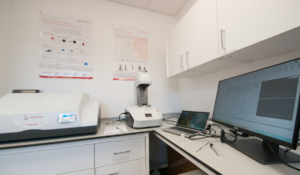 Particle Size Analysis is used for looking at the particle size distribution, this enables certainty in the quantification of the ceramic powders prior to going into ink-phase.
Once the ceramic is in the ink-phase, rheometry is used for looking at the liquid properties, such as viscosity and shear. This also is a very useful technique that helps ensure that the ceramic inks hold the right parameters prior to being printed.
Printing & drying capabilities
 Tapecaster and screen printer are the tools used for casting or printing thin and well-defined ceramic layers. The tapecaster makes up to 2m long uniform ceramic tapes (max width 30cm), whereas the screen printer is utilised for printing different geometries onto various substrates. Our screen printer can take 29″ frames and print as large as 50 x 50cm – one can print layer upon layer with precision and ease!
The large BTU belt oven is used for drying freshly made ceramic samples and has maximum temperature of 350°C and benefits from being fully extracted.
Imaging technique
 Benchtop SEM (Scanning Electron Microscope) is mainly used for looking at microstructure, it comes with EDX capability for elemental mapping. One great benefit with this benchtop SEM/EDX is that there is a low learning curve, and it enables the user to look at green samples or sintered samples with a short turnaround.
Precision cutting
 Laser cutter is for cutting tapecast ceramic samples and thin metals, it has a 150W CO2 laser that is capable of cutting anything from green ceramics to 1.5mm mild steel. The laser cutter’s bed size is a generous 130 x 90 cm, which ensures large flat samples can be cut with minimum materials wasted.
High temperature furnaces
 The furnaces are used for decarbonising and sintering the ceramic materials. The volume of each furnace is about 35 litres. They are programmable with respect to ramp rate and dwell times, max temperatures are 1100°C and 1400°C, respectively.
Ceramics processing & scale-up
This facility is ideal for SMEs seeking to enter or expand into the ceramics field, particularly where there is a view to investigate scale-up in a production environment of fuel cells. The facility comes staffed with technical support, convenient lab supplies and a separate hybrid workspace.
Please contact Professor John Irvine ([email protected]) for any enquiries.
Building 1, Eden Campus, University of St Andrews, Guardbridge, St Andrews, Fife. KY16 0US
Funded by the Low Carbon Challenge Fund (LCCF) through the European Regional Development Fund (ERDF)
